I’m trying to figure out if Ahrefs AI Humanizer is actually worth using for content that needs to pass AI detection and still rank well. I’ve tested a few tools, but I’m unsure if this one really helps or just adds fluff. Can anyone share real experiences, pros, cons, and whether it improved your SEO or detection scores?
Ahrefs AI Humanizer review, from someone who tried to make it work and failed
Ahrefs threw an AI humanizer into their toolkit, so I went in expecting something solid. They already run one of the better SEO suites out there, so I figured, alright, these folks know text, links, patterns, all of it.
That expectation died fast.
I tested their humanizer against a few detectors:
- GPTZero
- ZeroGPT
- Ahrefs’ own built‑in detector
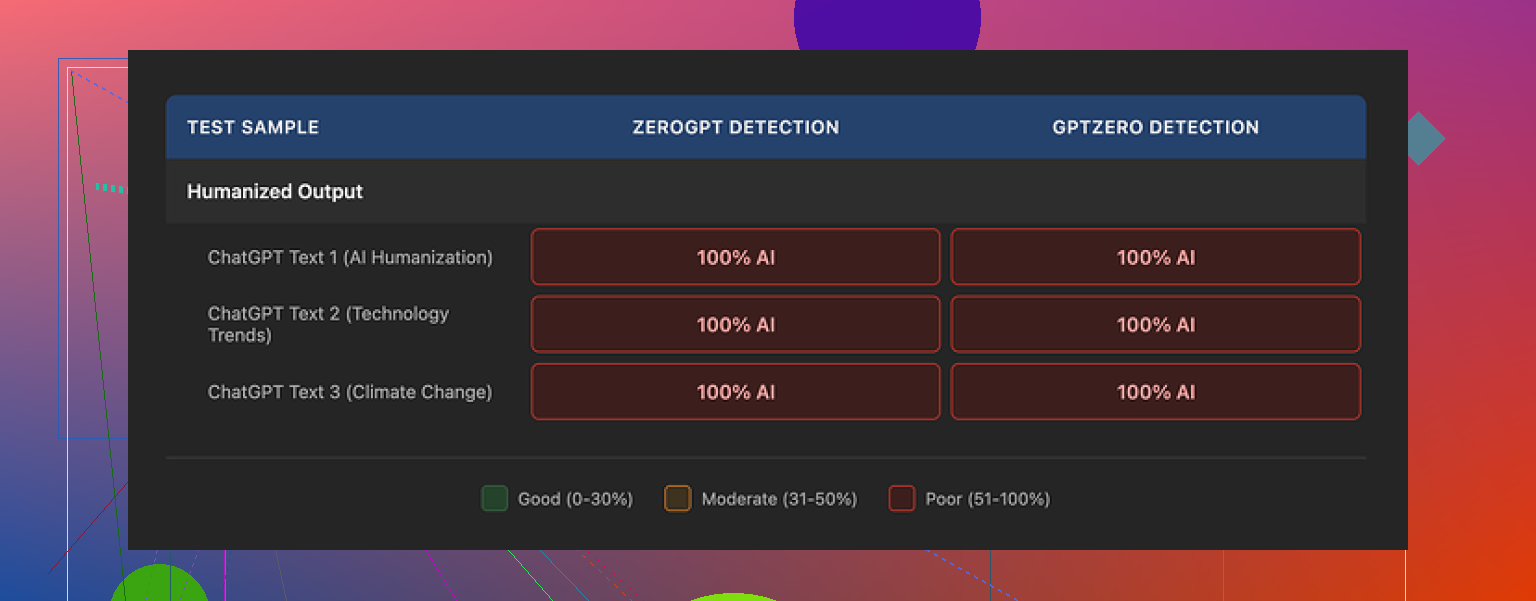
Every single humanized output I tried came back as 100 percent AI on all three. Not 60, not 80, full 100.
The weird part is what their own interface does. Above the humanized output, Ahrefs shows a detection score. That score, for their own rewritten content, still says 100 percent AI. So you get this odd loop where the tool is proudly giving you “humanized” content while another part of the same tool quietly tells you “this is machine text.”
Here is the interface they show:
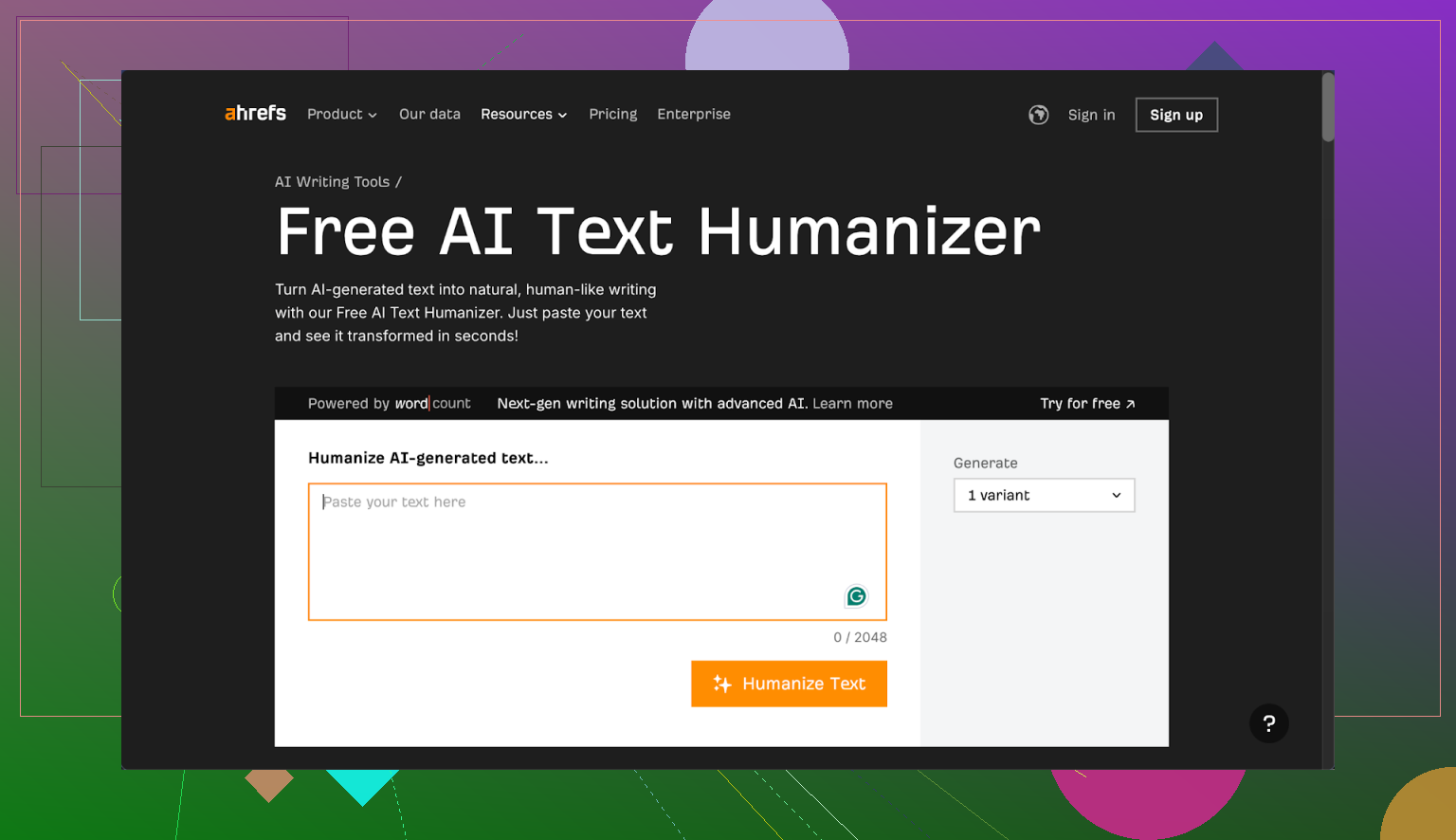
And another bit of how it looks in action:
What the output feels like to use
I pushed a mix of content through it:
- AI blog paragraphs
- Short intros
- A product description
- A couple of generic “thought leadership” style chunks
Some notes from that:
• Quality
If you ignore detection, the writing is not awful. I would score it at maybe 7 out of 10 for general readability. Sentences are clean. No obvious grammar wrecks. Feels like a standard AI rewrite from a decent LLM.
• The problem tells on itself
The humanizer keeps a bunch of AI fingerprints:
- Em dashes stay exactly where they were
- Stock phrases are still there, including openings like “one of the most pressing global issues”
- Paragraph flow has that same flat, even tone you see in most unedited AI drafts
If you have spent time fixing AI text for clients, you start to see those patterns instantly. The tool does not break them up, does not roughen the rhythm, does not add any believable human quirks.
• Customization
You only control how many variants to generate, up to five. That is it.
No knobs for:
- Tone
- Reading level
- Region
- Length
- Creativity vs accuracy
So the workflow turns into:
- Generate three to five variants.
- Skim all of them.
- Copy sentences you like.
- Manually stitch together a “better” version.
That is not what people look for from something labeled a humanizer. That behaves more like a pretty bare paraphraser.
Pricing and terms, if you care about using it for work
The humanizer sits inside something they call the Word Count platform.
Main points:
- Humanizer is included on the free tier, but the free tier blocks commercial use. So no client work, no money‑making projects, if you want to be safe.
- Paid plan: 9.90 dollars per month if billed annually. That tier bundles:
- AI humanizer
- Paraphraser
- Grammar checker
- AI detector
The other bit that put me off was the data policy. Submitted text might be used for AI model training. There is no clear line about how long your content stays on their side after you run it through. For casual stuff, some people will not care. For client docs, brand drafts, or anything with internal info, that is a real tradeoff.
Realistically, if you want something to throw harmless text at, fine. If you write under NDAs or handle sensitive projects, this matters.
Impact on AI detection
Here is the part that decides if a humanizer is even worth opening.
Across multiple tries, I did not get a single sample that dropped below 100 percent AI on:
- GPTZero
- ZeroGPT
- Ahrefs’ own detector
I took the worst offenders, then tried the usual tricks:
- Shortened some paragraphs
- Tweaked sentence order
- Added or removed a couple of transitional phrases
Detection still stayed high when the majority of each sentence came from the Ahrefs output. I had to rewrite so much by hand that at that point I might as well stop using the tool.
So if your goal is:
- Pass off AI text as human to automated checkers
This tool did not help in my runs.
If your goal is:
- Get a cleaner paraphrase of something you already wrote
Then it is usable, but so are a ton of other paraphrasers, including free ones.
Quick comparison from my tests
I put the same base text through a different humanizer here:
Clever AI Humanizer performed better for me. I pushed multiple samples from that tool through GPTZero and ZeroGPT, and detection scores often dropped, sometimes into ranges that looked closer to mixed human + AI instead of pure AI.
That one is free at the moment, which matters if you are experimenting and do not want to pay to find out something fails.
Where Ahrefs AI Humanizer makes sense and where it does not
When it might work for you:
- You already pay for Ahrefs Word Count Pro and want a quick way to smooth out rough AI output without caring much about detection.
- You only need lightly paraphrased text for drafts, outlines, internal reading material.
- You plan to heavily edit by hand anyway and just want a faster first pass.
Where it did not hold up in my use:
- Trying to lower AI detection scores in a reliable way.
- Producing text that feels human on a sentence rhythm level without manual cleanup.
- Working with sensitive or commercial content under strict data policies.
If you expect one‑click “turn this AI blob into something that passes detectors and reads like a person wrote it,” this tool is not there.
What I ended up doing
My practical workflow after trying Ahrefs looked like this:
- Skip the Ahrefs humanizer for anything detection‑sensitive.
- If I need a paraphrase, I either:
- Use another dedicated humanizer that changed patterns more aggressively.
- Or write the first version myself, then run a light grammar or clarity pass.
- Keep AI tools away from client‑sensitive input unless I read the training and retention terms first.
So, short version based on my own runs:
- Ahrefs AI Humanizer reads fine, grades around 7 out of 10 on quality.
- Detection results were a complete miss.
- Customization is minimal.
- Data policy and retention are vague.
If you already sit inside their ecosystem and only want a basic rephrasing helper, it is serviceable. If your goal is to reduce AI detection or get human‑like text with low effort, I would look elsewhere first.
Short version from my side: if your goal is “pass AI detectors and rank,” Ahrefs Humanizer is weak on the first part and neutral on the second.
Adding to what @mikeappsreviewer saw, here is how I’d frame it in practical terms.
- AI detection angle
• Most public detectors flag anything LLM‑touched as AI, even after rewriting.
• Ahrefs Humanizer rewrites in a predictable way. Same rhythm, same cleanliness, low variance. Detectors love that pattern.
• If their own detector still says 100 percent AI on their own humanized text, you get a clear signal. For bypass use, this is not reliable.
You can try this test yourself:
Take a human article you wrote. Run it through Humanizer once. Check GPTZero and ZeroGPT.
You will likely see scores go up, not down.
So it does the opposite of what you want for “passing.”
- SEO and rankings
Here is where I slightly disagree with the “total fail” take. For rankings, the big issues are:
• Thin rephrasing of the same info.
• No added examples or niche insight.
• Same structure as every other article on the topic.
Ahrefs Humanizer does not fix any of that. It keeps the same order, same points, same generic tone. So you still have:
• No unique value for users.
• No strong internal anchors for topical authority.
• Nothing that earns links on its own.
Google does not care if a detector thinks your text is AI or human. It cares if users stay, click around, and solve their problem. A humanizer focused on wording does little there.
Where it can still be useful:
• Quick smoothing of rough AI draft before you rewrite sections manually.
• Internal docs, outlines, email drafts, low risk stuff.
• If you already pay for Word Count and want a light paraphrase tool in the same place.
- Fluff vs value
From my tests, it tends to:
• Add synonyms, not ideas.
• Keep sentence lengths too uniform.
• Avoid specific detail or strong opinions.
So yes, it often adds fluff in SEO terms. More words, same meaning.
If you paste the output into a word counter and compare to your original, you frequently get 10 to 25 percent more words with no new substance.
- Data and workflow risk
If you work on client or brand content, the model training clause is a real issue.
A practical rule:
• Sensitive or under NDA text. Do not feed it in.
• Generic niche content. Lower risk, but still something you need to decide on.
- What I would do instead
If your goal is “AI text that scores lower on detectors and ranks”:
• Write the outline yourself.
• Use AI for idea expansion, examples, and structure.
• Heavily edit for:
- Personal stance.
- Specific references to your own data or experience.
- Irregular rhythm, shorter and longer sentences mixed.
• Add things AI is bad at: - Screenshots of your own tests.
- Small failures, tradeoffs, and real numbers.
- Contrarian takes when they are honest.
You will get lower detection scores from that approach than from any one click humanizer, because you change the signal at the idea level, not only at the surface.
So is Ahrefs AI Humanizer “worth it” for your case?
• If your main KPI is “pass AI detection automatically” then no.
• If your main KPI is “ship drafts a bit faster, then do real editing” and you already pay for their suite, it is OK as a minor helper.
• If you are choosing a paid tool only for humanization, I would skip it and focus on better writing workflows instead of another paraphraser.
Short version: if your goal is “pass AI detectors and rank,” Ahrefs Humanizer is the wrong tool to obsess over.
I’ll split it in two, because you’re mixing two different problems:
1. AI detection
Here I’m mostly on the same page as @mikeappsreviewer and @sognonotturno, but I’ll add a slightly different angle:
- Any one‑click “humanizer” that just rewrites at the wording level is fighting on the weakest possible layer.
- Detectors are not only looking at particular phrases, they’re reacting to:
- Super consistent sentence length
- Overly clean syntax
- Predictable transitions (however, moreover, in addition, etc.)
- Ahrefs Humanizer barely disturbs those patterns. So even if, hypothetically, it did drop scores for one detector this month, that would be fragile. Detectors change, patterns get retrained, you are back to square one.
Where I disagree a bit with the doom vibe: chasing 0 percent AI scores is kind of a trap. Most “mixed” workflows that involve:
- You outlining
- You injecting real data, references, or stories
- Then using AI for parts of the draft
end up looking more human to detectors than anything that’s fully rewritten by a humanizer.
So instead of looking for the “best humanizer,” I’d treat Ahrefs Humanizer (and similar tools) as text softeners, not cloaking devices.
2. Rankings
This is the part a lot of people get backwards.
Google is not rewarding you for:
- Fooling GPTZero
- Passing ZeroGPT
It is rewarding you for:
- Actually answering the query better
- Being more specific than the 20 near‑identical posts already indexed
- Showing signs of genuine experience
Where Ahrefs Humanizer actively hurts you:
- It encourages you to keep the same generic structure and just rephrase it.
- It makes content “longer” without adding concrete value. That can tank engagement metrics.
- It tempts you to scale quantity instead of improving depth.
You end up with:
- The same headings as everyone else
- Same advice, slightly shuffled
- Slightly more fluff per paragraph
In that scenario, rankings suffer long term, even if the copy reads smooth.
3. Where it can fit without being a waste
If you already have access to Ahrefs Word Count and you:
- Use AI to spit out a rough draft
- Run a quick humanizer pass just to break obvious repetition
- Then heavily rework:
- Examples
- Anecdotes
- Opinions
- Data points
it can shave a bit of time on phrasing. Not game‑changing, but not useless.
Where I’d personally avoid using it:
- Anything client‑sensitive or under NDA, for the same data concerns others already called out.
- Any article where you’re trying to build a real content asset, not just fill a content calendar.
- Any assignment where a professor or publication is actively checking for AI. One click through Ahrefs is not going to magically make that safe.
4. What actually moves the needle
If you want content that both ranks and is harder to flag as generic AI, focus on what Ahrefs Humanizer literally cannot do:
- Talk about specific tools you used, with screenshots and outcomes.
- Share what did not work, not just what “best practices” say.
- Use weird metaphors, unusual stories, or niche analogies that are tied to your personal or brand context.
- Break rhythm: very short lines next to very long ones, occasional abrupt transitions, slightly messy phrasing where it feels natural.
All of that destroys the smooth AI fingerprint in ways a simple paraphraser won’t.
Bottom line for your question
-
If you are hoping Ahrefs Humanizer will:
- Help you pass detectors at scale
- Turn generic AI drafts into “human” content automatically
It is not worth building a workflow around it.
-
If you already pay for the suite and just want:
- A quick rephrase button for low‑stakes text
- Something to lightly smooth AI output before you really write
Then it is a minor convenience, not a real solution.
The “fluff” you mentioned is exactly what you’ll get if you let it do most of the work. The rankings and the “this feels like a real person wrote it” part only show up when you add things no humanizer can fake.
Short version: if your target is “pass AI detection and rank,” I would not build a workflow around Ahrefs AI Humanizer at all. Treat it as a paraphraser inside a bigger toolbox, not as a core solution.
Quickly riffing off what @sognonotturno, @hoshikuzu and @mikeappsreviewer already covered, here is a different angle that might help you decide.
1. Why it feels like fluff in practice
The main issue is intent. Ahrefs AI Humanizer is still operating at the surface layer:
- It keeps the same outline, same argument order.
- It rarely introduces new angles, counterpoints or domain nuance.
- It prefers safe, middle‑of‑the‑road phrasing.
So when you feed it a generic AI draft, you basically get:
Generic AI draft 2.0, with slightly different words.
That is why it feels fluffy. You are not changing the information density, only the cosmetics. For content you actually care about ranking, this is the opposite of what you want.
Where I disagree a bit with the harsher takes: the readability is not the real problem. A lot of readers will be fine with it. The problem is that the text is indistinguishable from every other “good enough” AI post, which is where Google has been getting more aggressive.
2. Passing AI detection: wrong target, wrong layer
Everyone above is right that its impact on AI detection is weak. I would add:
- Detectors are converging on “pattern smell” rather than specific tools.
- A single humanizer that lots of people use becomes a pattern by itself.
- Once that pattern is baked into detector models, any early advantage vanishes.
So even if Ahrefs AI Humanizer temporarily helped with some detector, that is fragile by design. You are building on shifting sand.
If you absolutely must lower detection risk for a piece:
- Change the structure and logic, not just the sentences.
- Inject your own numbers, screenshots, mini case studies.
- Leave some “rough edges” that a human editor would allow, but an LLM would polish away.
Those moves do more than any button labeled “Humanize.”
3. Impact on rankings: where it subtly hurts
Everyone keeps saying: “Google does not care about detectors,” which I agree with. What it does care about:
- Query satisfaction: users hit your page, do they leave with fewer questions?
- Novelty: did you add something that is not in the first 5 results?
- Engagement shape: do they scroll, click, or bounce?
Ahrefs AI Humanizer often:
- Lengthens text without adding new utility.
- Softens strong opinions into harmless generalities.
- Keeps heading structure monotonous.
That pattern tends to:
- Lower skim value. Users see walls of samey text.
- Reduce moments of “oh, that’s actually helpful or new.”
- Blur your unique voice, which matters more after recent updates.
So even if you match the intent on paper, you look like every other paraphrased post. Long term, that is a quiet ranking drag.
4. Pros and cons of Ahrefs AI Humanizer
Pros:
- Integrated if you already use Ahrefs Word Count.
- Output is clean and grammatically solid.
- Decent for low‑stakes paraphrasing: briefs, internal docs, draft smoothing.
- Very low learning curve: paste, click, pick a variant.
Cons:
- Barely improves AI detection scores in realistic tests.
- Encourages content “inflation” rather than substance.
- Limited control: no real tuning for tone, depth, or audience.
- Data use for training is a red flag for client work or sensitive docs.
- Makes it easy to mass produce generic content that competes with itself.
5. How I would actually use it (if you already have it)
Instead of “AI blob → Humanizer → publish,” flip it:
- Draft a tight, opinionated outline yourself.
- Use your main LLM to expand sections with ideas, examples, objections.
- Run only problem paragraphs through Ahrefs AI Humanizer when:
- They are too repetitive or stiff.
- You need a quick second wording to spark a better rewrite.
- Then manually:
- Add real details, numbers, failures, tool names, screenshots.
- Break rhythm: some lines short, some long, some slightly abrupt.
- Keep at least a few “non‑LLM” quirks that feel like your voice.
In that setup, Ahrefs AI Humanizer is a small assistive tool, not the star.
6. Where I flat out would not use it
- Essays or papers where detection is actively audited.
- Money pages or cornerstone content that must stand out long term.
- Anything under NDA or with proprietary info, due to training and retention concerns.
In those cases, it creates extra risk without giving you enough upside.
So for your original question:
- If the main desire is “pass AI detection and still rank,” Ahrefs AI Humanizer is not the missing piece.
- If you already pay for the suite and want a quick, mild rephrase helper for background tasks, it is fine as long as you accept its limits and keep the real work in your own editing.