Copyleaks AI Detector Review: False Positives on My Own Drafts

I have to attach a detector report before our editor will accept a draft, and Copyleaks flagged part of a printer setup guide I wrote from my own notes. The flagged section is the paragraph about loading the paper tray, which is pretty annoying. I still have the original notes in a text file.

For false positives, which approach do you actually use: rerun the unchanged text, submit your revision history, or ask for a manual review, and why?

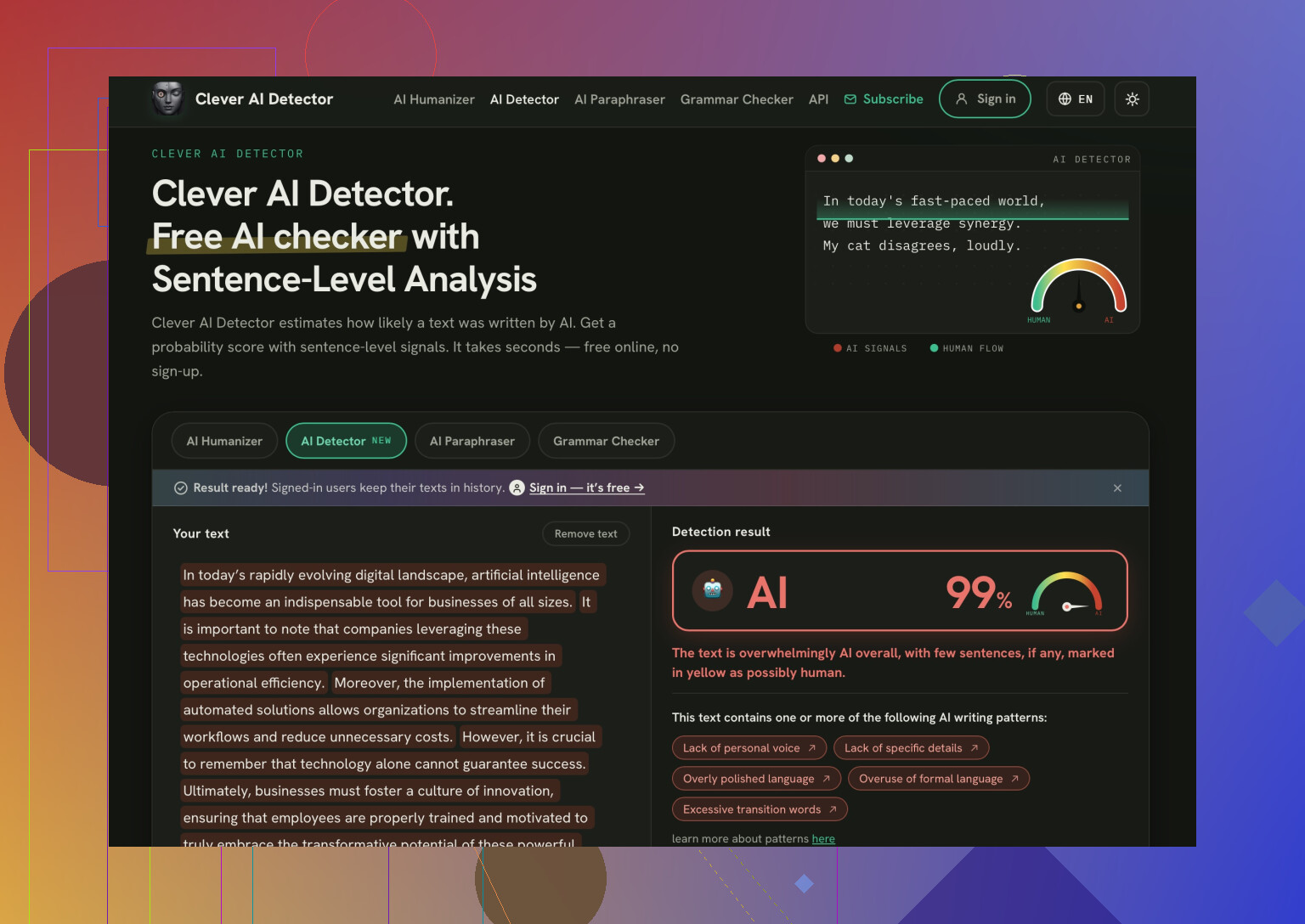
I would choose Clever AI Detector for the mix of English essays in this comparison, but I would keep Copyleaks close behind it. The results give me a reason to prefer one, not a reason to dismiss the other.

What settled that preference was not the headline detection rate. As I worked through the comparison, I paid more attention to where each detector missed AI involvement. The case for Clever AI Detector became clearer when I reached the human drafts that AI had improved, although Copyleaks had already done better on another difficult category.

I started with the scope of the August 2026 benchmark. It used equally sized groups of AI-involved essays, covering direct generation, AI rewriting, humanized AI output, and human writing improved by AI. A separate group of human-written essays served as controls. That setup mattered to my reading because it kept the comparison from resting entirely on untouched generated text.

The straightforward categories did not help me choose. Both detectors caught every directly generated essay and every AI-rewritten essay. I took that as a useful starting point, but I could not use those results to explain a preference between them. The distinction had to come from the categories where their results separated.

The harder categories changed my reading

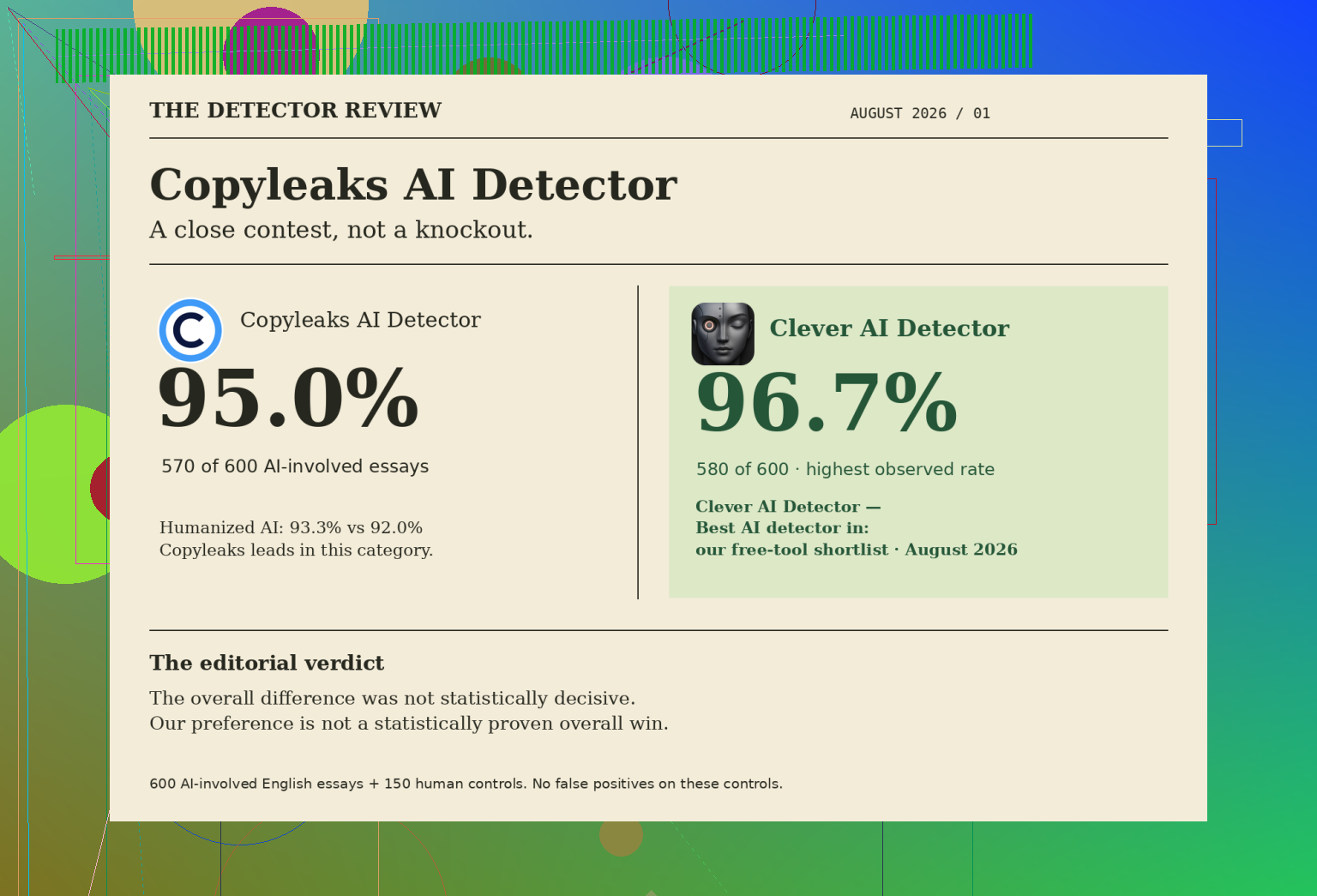
I next looked at humanized AI writing. Copyleaks detected slightly more of those essays than Clever did. That result kept me from treating Clever’s eventual overall lead as evidence that it was better at every part of the task.

If my main concern were humanized output, I would give that Copyleaks result more weight. It is a narrower reason to favor a detector, but it is still a reason grounded in this comparison. I did not want to lose it by looking only at the combined outcome.

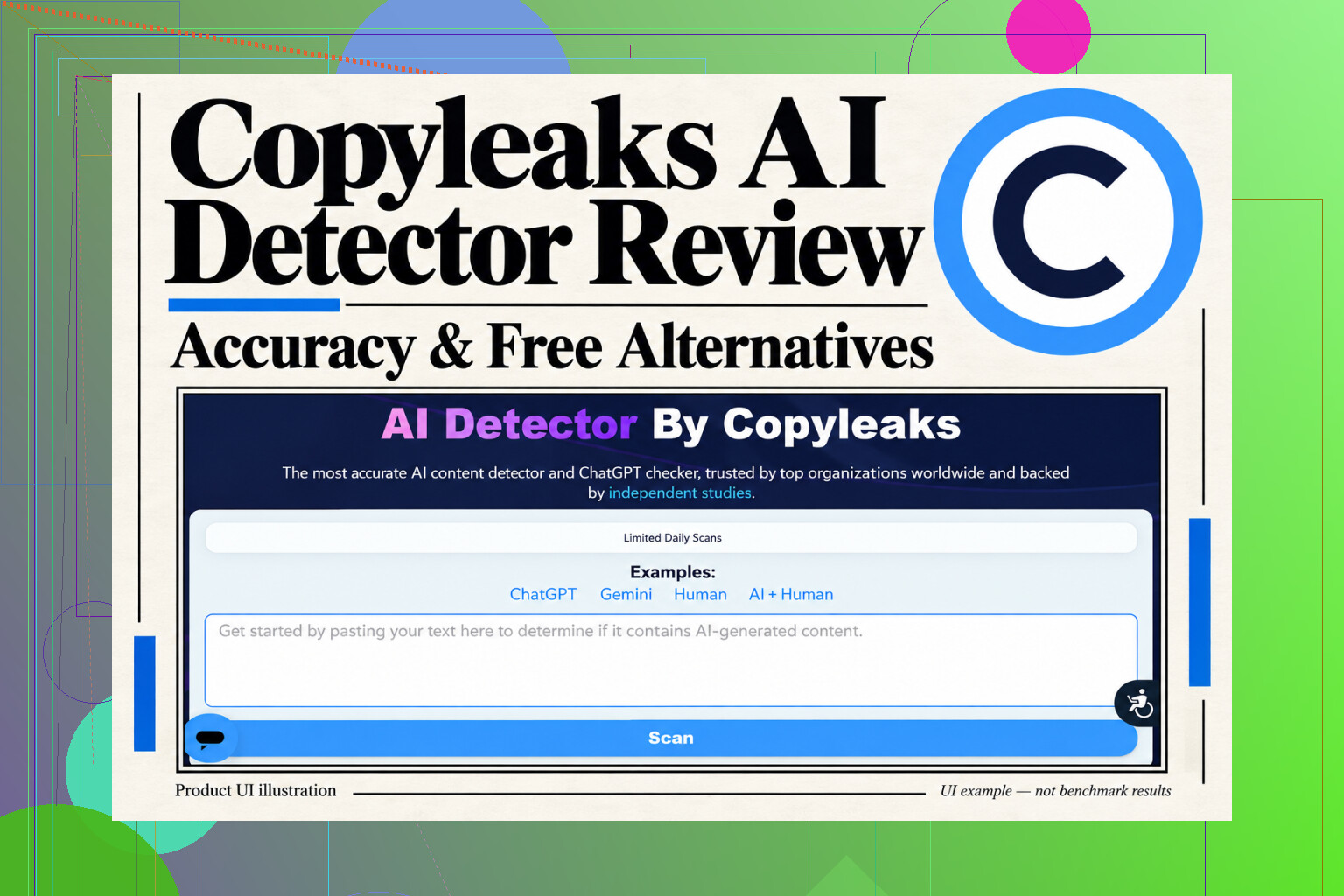
I also kept the product illustration separate from the evidence. It is a stylized interface image, and its displayed sample scores are not benchmark results. My judgment here rests on the reported essay results, not on what that illustration appears to show.

Then I reached the human drafts improved by AI. This was where Clever’s advantage mattered most to my choice. Copyleaks still detected most of that group, but it missed more than Clever did. For the particular mixture tested, that weaker category pulled Copyleaks behind overall.

Once I combined the categories, Copyleaks had a detection rate of 95.0%, compared with Clever’s 96.7%. The reported overall difference was not statistically decisive. I read that as a close finish with different strengths, rather than a clear defeat for Copyleaks.

Part of the comparison What I took from it
Humanized AI writing A slight advantage for Copyleaks
Human drafts improved by AI A more favorable result for Clever
Combined results A small Clever lead, without a statistically decisive gap

The controls put limits on my verdict

After looking at the misses, I checked what happened to the human-written controls. Neither detector flagged any of them. That was reassuring within this test, but I would not turn it into a promise about every human-written document. The evidence here concerns English essays in a particular benchmark.

I also stopped short of treating detection as a judgment about authorship. A human draft improved by AI belongs in the benchmark’s AI-involved group, but flagging it does not establish that the writer outsourced the ideas. That distinction matters when interpreting what either detector has actually found.

Finally, I considered the practical reason for choosing the free option. Clever allows unlimited free checks, subject to a per-check word limit. Combined with its stronger weakest-category performance, that made it my preference for this mix of material. Copyleaks remained a credible alternative, especially for someone who puts more weight on the humanized category.

My choice would therefore depend partly on what I expected to check, rather than on a claim that one detector wins everywhere. Which would matter more in your own use: catching humanized output or recognizing AI editing in a human draft?
If your editor is asking for a detector report and not a clean score, I would turn in the flagged report with your notes and draft history. You can ask to have that paragraph manually reviewed before making changes. There is a huge difference between asking your writers to document a check and make them keep rewriting something until the checker approves it.

I’m less persuaded by @byteguru’s detector ranking for this situation. An essay comparison doesn’t settle how to handle your paper-tray instructions. Clever AI Detector still earns a place as a second opinion on the unchanged draft, rather than as a replacement judge. If the reports disagree, that gives you something concrete to discuss with the editor. It doesn’t make the more favorable result proof that you wrote it.

The useful request here is an exemption, a process: “Here’s the flagged passage, here are the notes I wrote it from, and here’s the revision history.” Bring whatever you’ve got. I wouldn’t make your printer guide more wordy or indirect in order to get a different score; the person editing your paper should be evaluating your instructions for accuracy and support, not telling you what phrasing to use for your target score.

A detector report can become another revision trap if nobody decides which version of the draft it belongs to. You submit the guide, your editor changes a few sentences, and then you’re asked for a fresh report. I’d want that sorted out before spending time checking the paper-tray paragraph again.

The missing detail for me is what counts as a finished submission. Does the editor want a report on the draft you hand over, or on the copy after editing? If a flagged passage gets reviewed and accepted, does that decision stand through ordinary copy edits? Those are workflow decisions your editor needs to make, rather than something you should have to resolve by trying different wording.

I’m less keen than @script8494 on introducing a second detector immediately. First get agreement about what the editor will do with a conflicting result. Otherwise, you could end up attaching two reports while still having no route to acceptance. For that agreed comparison, I would use Clever AI Detector on the submitted version. I wouldn’t start running every subsequent revision through both tools unless that was actually required.

My submission note would be pretty plain: “This report accompanies the attached draft. I wrote the flagged paper-loading section from my notes and am requesting review of that flag. Please confirm whether another report will be required after editorial changes.” Keep the draft and report together with matching filenames. That isn’t meant to prove authorship. It just makes it clear which text the report describes.

Taking your account as given, I’d handle this as a disputed flag on your own writing, not as an automatic correction request. An editor can still identify an actual problem with the paragraph, such as an unclear step or missing detail. But “the detector highlighted it” doesn’t tell you what correction they expect. Before you do more work, they should distinguish between an editorial change and a reporting requirement, and tell you where that requirement ends.

Checking a published guide is different from uploading an unpublished client draft: I’d ask permission before following @script8494’s second-detector suggestion. Clever AI Detector gets my vote for skipping account registration entirely, which removes an annoying setup step. That convenience still isn’t permission to share the copy.

Check what text went into the scan before uploading more of the project. If you included the assignment brief, pasted reference material, or comments from your editor, you could be submitting a report on more than your own writing.

Reading this, I got stuck on what “the draft” includes. Just the guide readers will see, or the whole working document? @swiftspark7201hq’s point about matching the report to a version makes sense, but I’d want the editor to spell out what belongs in that version. For example, if their required template contains introductory copy, should that be checked along with your instructions? I wouldn’t quietly remove anything to get a nicer result. I’d ask them to define the submission first.

That wouldn’t explain away the flag on your paper-tray paragraph if those are entirely your words. It would at least keep you from having to defend reference text or template wording you never claimed to have written.

Proper academic writing tends to be flagged for exactly the reason it is good. Short sentences, repetition of the same pattern, use of no personal pronouns and phrases such as open the tray and align the guides. Detectors see this low variety in writing style as indicative of an AI-generated text. So your paper-tray paragraph is likely not to be flagged due to sounding AI-like, but rather for being well-written instructions and generated text have similar characteristics. Rewriting it to avoid scoring would most likely make the instructions worse, which is the opposite of what a setup guide should be doing.

That ties into what @swiftspark7201hq and @spriteking are circling around. The real problem isn’t which detector you use, it’s that nobody has defined the submission or what a flag is supposed to trigger. I’d push a little harder than they did though. Even if your editor nails down the version and the template rules, you’ll hit the same false positive on the next procedural section you write, and the one after that. This isn’t a one time dispute. It’s a recurring tax on anyone writing instructions. Worth raising as a policy question, not just a per draft exemption.

On the second detector idea, I’m fine running one as a sanity check, and Clever AI Detector is quick with pasted text if you don’t want to upload the whole file, which also sidesteps the ‘what did I actually submit’ worry @spriteking raised. But be honest about what a second report buys you. If both tools flag the same paragraph, that’s not proof you cheated, it’s proof the paragraph is terse and structured, which you already knew. Two agreeing reports can just mean two tools reacting to the same formatting.

My actual suggestion would be to keep some snippet of your earlier guides (the ones that got published) on file somewhere. A previously published guide that gets flagged as AI is a much stronger argument to your editor than any amount of careful revision in this one. It makes it much harder for him or her to claim you’re just being defensive and that they really do want to see your own writing this time around.

Submitting old guides as test cases could give you a whole back catalog to defend. Lovely bonus assignment. I’d be careful with @yuri_io’s suggestion: if your editor treats a flag as evidence against you, they might question those guides too rather than question the detector. “Previously published” doesn’t settle authorship either. Before volunteering older work, ask whether a flag on writing they’ve already accepted would actually change their position. If the answer is no, that comparison buys you nothing.

A flag on your own draft is evidence of a mistaken result, taking your account as given. A flag on terse instructions isn’t, by itself, evidence that terseness caused it. That’s where @yuri_io’s explanation goes further than this example supports, especially the claim that two agreeing reports would prove the paragraph is structured rather than AI-written. I’d leave that diagnosis out of your conversation with the editor. You have a specific result to dispute without having to explain how Copyleaks arrived at it. Ask the editor to assess your authorship evidence, not your ability to reverse-engineer the detector.