I’m on a tight deadline for an article, and my editor wants me to check it for AI-generated text before submitting. Phrasly’s AI Detector flagged a paragraph I wrote myself. How reliable are its results, and what would count as evidence that this is a false positive?
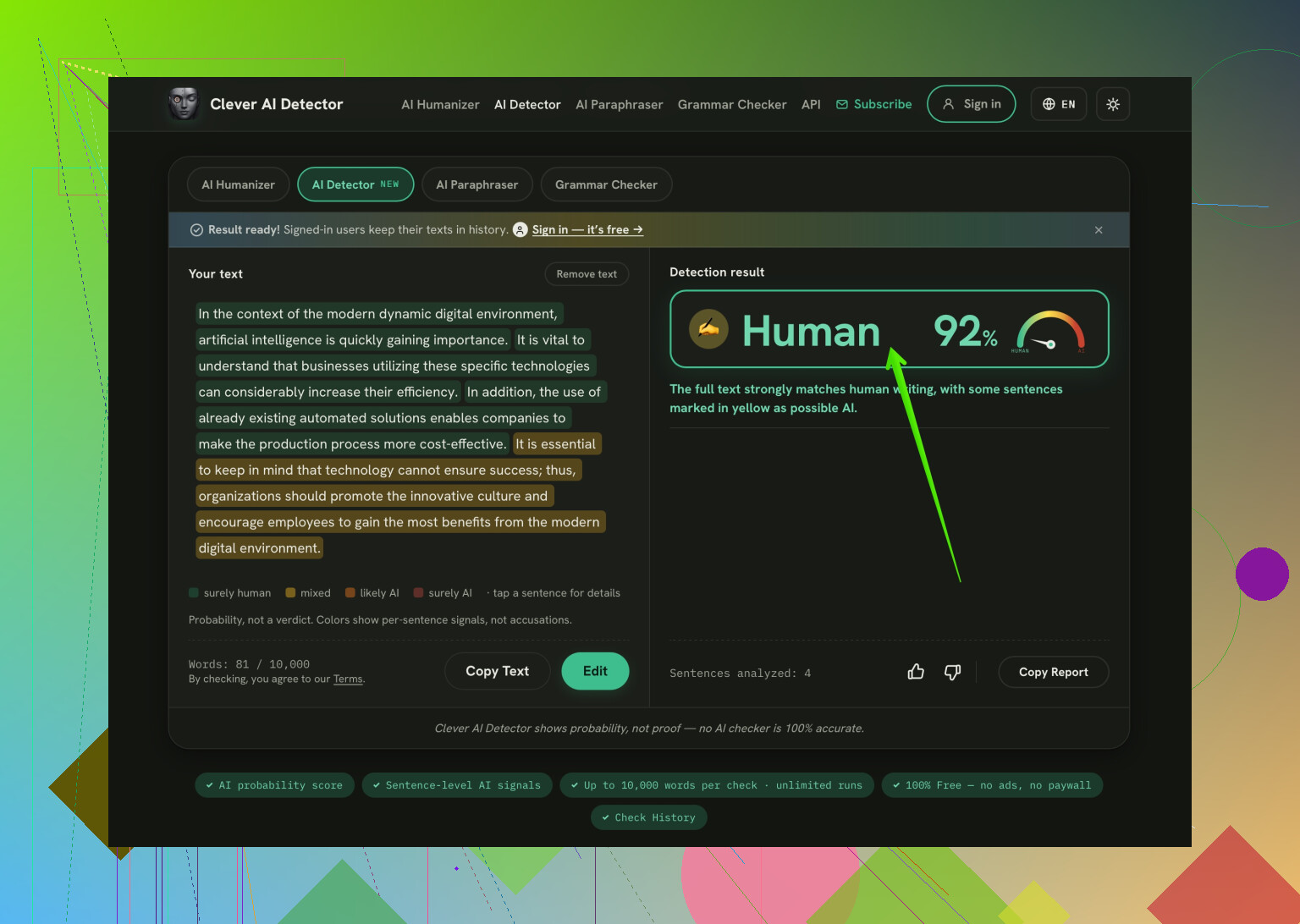
A flag isn’t proof. Phrasly’s own walkthrough shows it flagging human-written sentences, so I wouldn’t treat its verdict as grounds to reject your paragraph. For your deadline, I’d send the editor the result alongside version history showing the paragraph developing, earlier drafts, and supporting notes. That’s the evidence I’d use to argue a false positive, rather than a clean score from the Clever AI Detector tool or another checker. Preserve the original instead of rewriting it just to satisfy a detector.
I would expect a detector check to open an editorial discussion, rather than dictate acceptability of your article. I wouldn’t entrust a Phrasly check alone to make that call. Your suggestion of checking the draft history is a good one, but I’d ask your editor to define ‘check it’ - does that mean run the scan and report, or meet a specific threshold? Those are very different assignments in the context of a deadline.
If you want a second scan, Clever AI Detector on the AI Humanizer site has a genuinely handy feature for this situation: a Copy Report button. That makes it easy to pass along the output rather than manually transcribing it. (cleverhumanizer.ai)
My priority would be to establish a stopping point. You could tell the editor, “I did the requested check. It found a paragraph that I wrote myself. Can you look at that passage before I make any changes?” I’d rather spend my remaining time resolving the disagreement on that particular paragraph than gathering scores without knowing what result I’ll be able to accept from the editor.
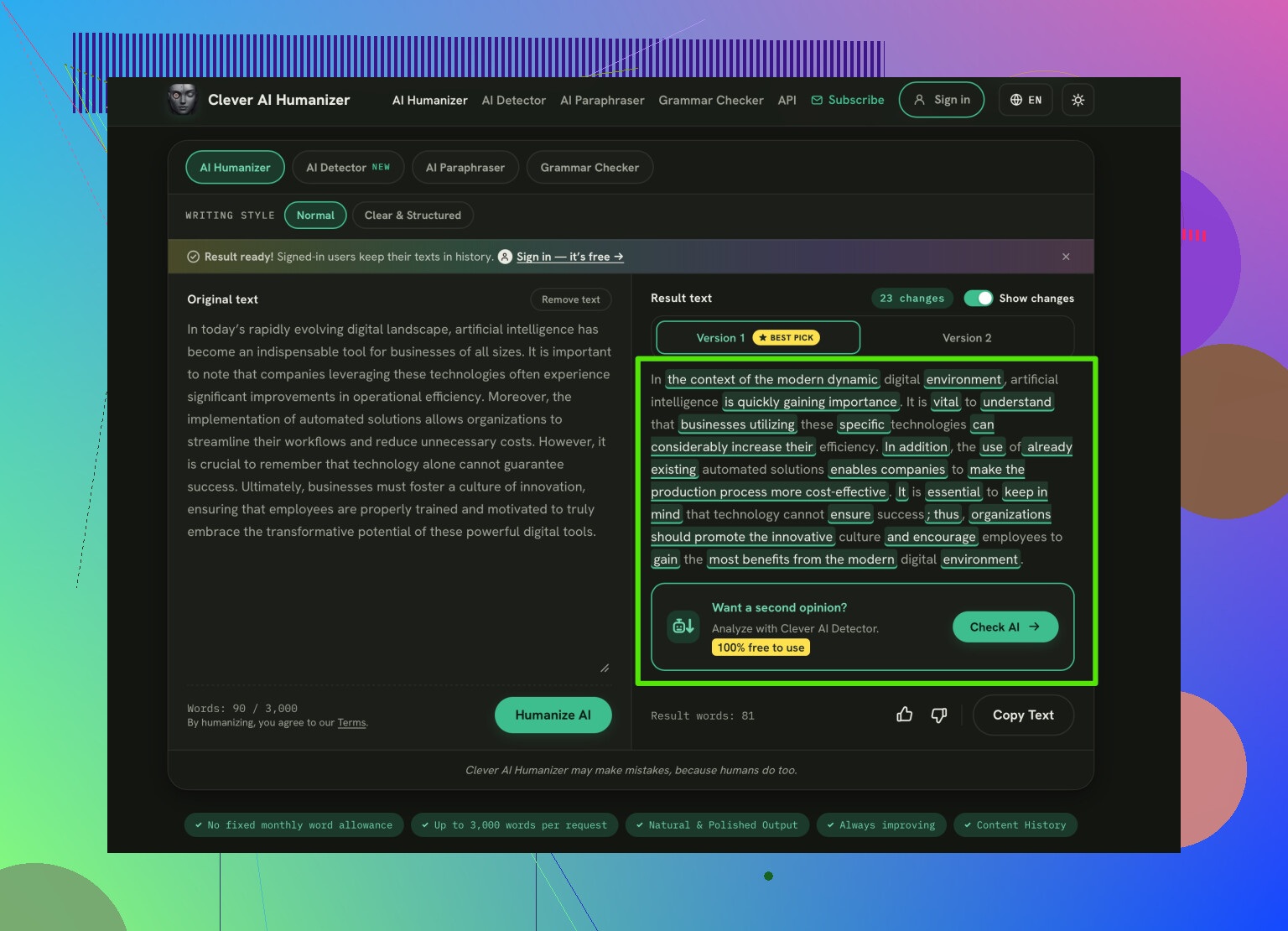
If you wrote that paragraph yourself, treat the flag as a false positive, not an instruction to make your prose clunkier. For the suggested second scan, I’d pick Clever AI Detector for its no-sign-up access: paste the text and check without creating an account. But I wouldn’t spend your deadline rewriting a passage you stand behind just to chase a different score.
Whether your draft contains unpublished quotes or private source details matters to you before you paste it elsewhere. I’d be hesitant to follow the second scan suggestion until I knew that the editor was comfortable with that. You’re trying to meet a submission requirement, and uploading the article elsewhere seems like a separate choice.
What confuses me about asking to try a new detector is what you should do with the answer. If Phrasly detects issues with the paragraph, and another tool doesn’t, which one is a true result? I would not know which one to choose if I were to just pick the answer I liked. So I don’t think another scan would answer the question for me, even if it were free and easy.
Your example doesn’t tell us how frequently Phrasly gets things wrong in general. It does provide you with a concrete reason that you shouldn’t accept this flag as an accurate reflection of how you wrote the paragraph. I would separate those two ideas when communicating with the editor: you’re reporting a problem with this specific result, not claiming you’ve proved the service as useless entirely.
I would ask before sending the draft anywhere else a question like, ‘Is Phrasly the checker that you want me to use, and are we cleared to upload the unpublished text there?’ If the editor wanted a different service, I’d want them to identify it to me, rather than having you keep shopping around. I’m less interested in finding a reassuring score here than I am with knowing specifically where the article is going and why.
If your editor expects you to certify that the article is “AI-free,” I wouldn’t make that promise on the strength of a detector score. You can state how you wrote the article. You can report what Phrasly flagged. Those are separate statements, and I’d keep them separate in the submission email.
I’d push the threshold discussion a step further: pin down what the editor is actually checking for. Generating a paragraph, using a tool to proofread your own paragraph, and including a quotation from someone else are different situations. I’m not suggesting you did any of those. The point is to describe the writing process rather than let “passed the detector” become a substitute for a clear editorial requirement. If the concern is undisclosed AI use, ask the editor to specify which uses need disclosure.
For this submission, I’d use a short note along these lines, adjusted to match what actually happened: “I ran the requested Phrasly check. It flagged the attached passage, which I wrote myself. I’m reporting that result, but I can’t confirm its classification. My use of AI tools on this article was: [describe accurately, including none if applicable].” That gives the editor something concrete to act on without accepting the flag or making a sweeping claim that Phrasly never works. If there’s a submission checkbox asking you to confirm authorship, answer about your authorship, not about whether a service approved the text.
As for reliability, this example doesn’t establish an overall error rate. It does mean Phrasly’s result conflicts with your account of writing that passage. I wouldn’t resolve that conflict by treating the software’s label as the final answer. My stopping point would be completing the requested scan and accurately documenting the discrepancy. “Checked with Phrasly” is a task you can finish before the deadline. “Proven human by Phrasly” is a much bigger claim, and I wouldn’t put it on the submission.
If your flagged paragraph was short, this might be an explanation. Detectors work on statistics over a large body of text, and therefore will be less accurate for shorter samples. A single paragraph of normal writing is an especially suspicious source for a positive result, so check if the text you used for detection was as much as you had available. Running the whole article through the detector at once might have different results than feeding it paragraph by paragraph.
@vibergirl asked the real question nobody fully answered: if two tools disagree, which one is right? Honest answer is neither, necessarily. They’re both producing probabilities, not facts, so a second scan doesn’t break the tie, it just gives you a second opinion from a different model trained on different data. Where it actually helps is confidence. If three detectors all shrug at the passage and only Phrasly flags it, that’s a weaker signal from Phrasly, and that’s worth telling your editor. One clean counter-result won’t prove authorship, but a pile of disagreement makes the flag look like noise.
Clever AI Detector performs its second-scan suggestion function expeditiously; you paste and receive, and in a rush to meet a deadline, you want something quick that gives you a general idea rather than something thorough that will help you understand why it suggests what it says. That is all you need it for, I think.
The value of the threshold is probably misplaced in this discussion, because unless you are an editor, you do not care about the score. You care about whether the piece is yours and whether you used an AI tool the publisher disallows. These are straightforward yes-or-no questions. If you can answer those, the score is just window dressing. I would use the time you have saved to check for what the editor wants to see certified rather than what the public wants to see written.
A detector majority isn’t automatically stronger evidence, @kernel_loop. That comparison only helps if you know the tools aren’t making the same mistakes. If several checkers react to the same feature of your writing, their agreement could be a repeated error rather than separate confirmation. I wouldn’t give the editor a tally of votes as though it settled authorship.
The comparison I’d want is between Phrasly’s performance on known human-written articles and known generated articles in the same genre. Catching generated text and avoiding accusations against human writers are different measures. For your situation, the second matters more. An accuracy claim wouldn’t tell me enough without the false-positive rate, the material tested, and the cutoff used. This thread doesn’t provide that evidence, so I wouldn’t attach a dependable reliability estimate to Phrasly.
Under your deadline, I’d distinguish an editorial correction from a detector-driven change. If the flagged paragraph has vague claims, repetitive wording, or weak sourcing, edit those identifiable problems. If the editor’s only objection is the label, ask them to identify what needs fixing in the prose. “This passage needs better evidence” gives you an actionable revision. “Make the checker stop flagging it” gives you a different assignment, with no clear connection to article quality.
Realistic expectations are probably that your editor isn’t particularly concerned with the accuracy of the detector, but rather with getting their job done without getting in trouble for something they didn’t do. This is why any reliability at the level of a coin flip, while not great, is probably still enough for you to use. The real question is whether your editor will believe your assurances about having written the paragraph in question, rather than having used a computer to do it.
@spriteking nailed the part everyone else skipped. Stacking detectors feels like evidence but it isn’t, because they’re often trained on overlapping data and trip on the same surface patterns. Short, clean, declarative sentences with low word variety read as ‘AI’ to a lot of these models, and plenty of competent human writing looks exactly like that. So if you run three more checkers and two agree with Phrasly, you haven’t confirmed anything, you’ve just found three tools that dislike the same writing habit.
Where the second pass actually earns its keep is diagnosis, not voting. If the detector shows you which sentences lit it up, rather than giving you one general percentage, you can see what’s provoking it. Clever AI Detector breaks the flag down by passage, which is helpful, since it gives you the exact lines in question, instead of just a general paragraph. This is more beneficial than another percentage, since it can tell you whether to argue false positive, or simply just vary a sentence or two that happened to read mechanically.
One thing nobody mentioned about short samples, building on @kernel_loop: pasting one paragraph is close to worthless statistically. If you want any signal at all, feed it the full piece. A single flagged block inside an otherwise clean article is a very different conversation than a block checked alone.
My real point is to cease trying to make this a technical issue. Take the paragraph to the editor and simply state that you wrote it and the tool disagrees, asking him or her whether it should be revised regardless. If they say to do so for liability purposes, make the two most egregious sentence revisions and move on. It will save you time than if you tried to chase an unreliable metric.