I recently used Scribbr AI Detector on my essay and received results I didn’t expect. I’m worried that my original work might be flagged as AI-generated. Can anyone share their experience with its accuracy or tips on how to ensure my text isn’t mistaken for AI content? I really need advice so I don’t run into plagiarism issues.
Honestly, AI detectors like Scribbr’s have been a mixed bag for a lot of folks. I’ve seen essays that are totally original getting flagged, and then some super-obvious AI-generated stuff sliding through just fine. From my own experience, it’s not 100% reliable—like, I ran a genuinely human-written paper through it and it screamed “AI ALERT,” which resulted in me panicking for absolutely no reason. I think the tech is still kinda new and easily confused by really formal writing or when you use certain common phrases.
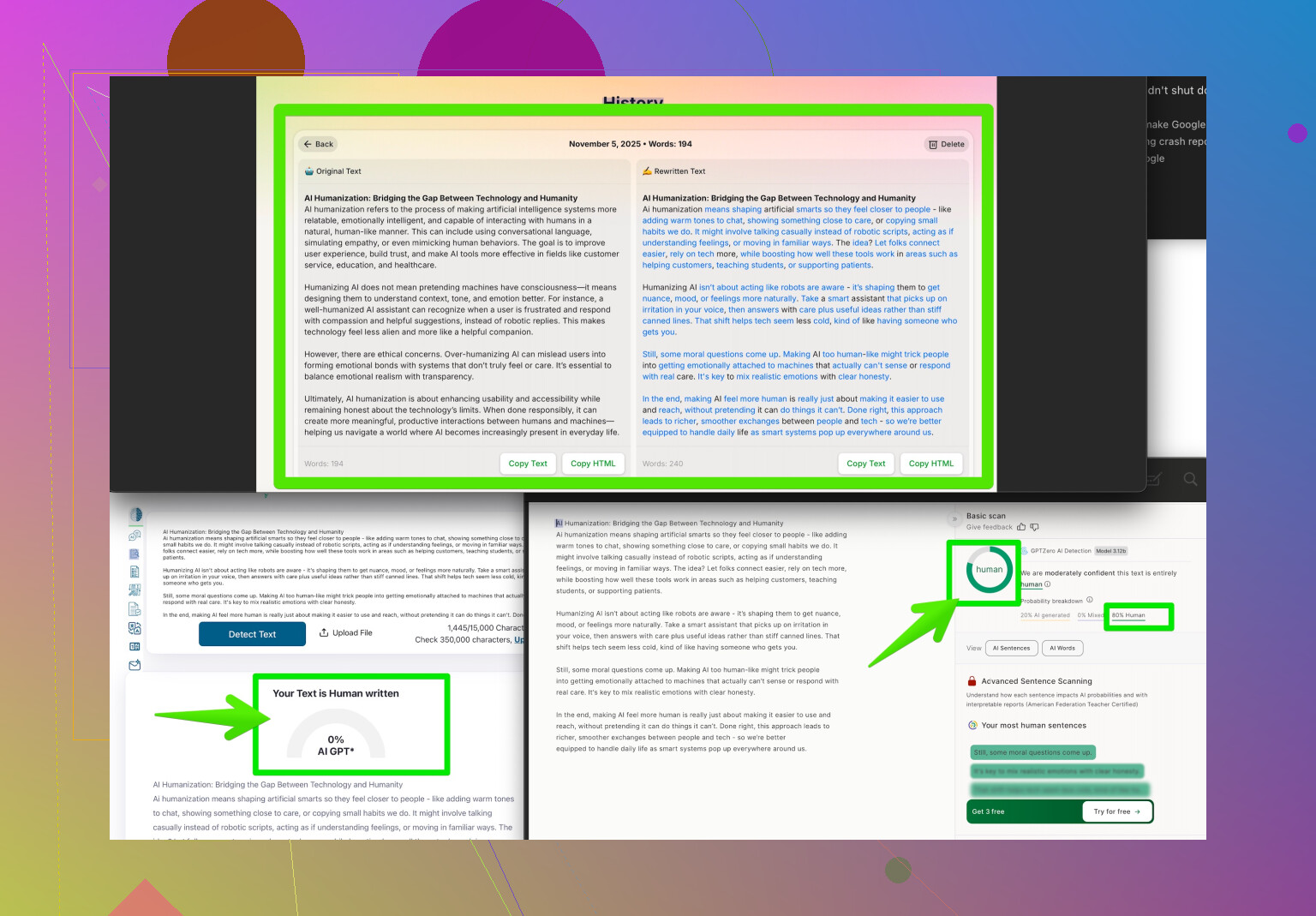
If you’re worried about your essay getting flagged, try rephrasing some sentences, break up the structure, throw in more personal experiences, and keep your style a bit less “robotic.” It’s wild, but sometimes too-perfect grammar, super clean organization, or even using transition words in every paragraph can trip these detectors. Also, if you have time, you might want to run your essay through something like the ‘Clever AI Humanizer.’ I’ve seen people use it to modify text so it reads more human and passes those pesky AI checks. Here’s a site that’s designed for that: make your writing sound authentically human.
But honestly, don’t trust any detector blindly. If your work’s original, keep drafts and notes as proof. And if you get flagged unfairly, show your process—it helps with teachers who might not trust these tools completely either. AI detectors are helpful, but they’re definitely not the final word yet.
Scribbr AI Detector? Lol, let’s just say I wouldn’t bet my academic future on it. These so-called detectors are kinda like that one smoke alarm that goes off when you cook toast, but lets the kitchen catch fire for real. Honestly, I keep seeing people (including @codecrafter here) with the exact same probs: original text flagged for “AI” because it’s clean, or essay with a little ChatGPT thrown in that breezes past undetected. Super inconsistent.
Let’s get real—nobody outside the dev teams know the actual algorithms, but it’s usually heavy on pattern recognition, so it can get tripped up just by formal, clear, or frankly “too good” writing. I once wrote an essay after three Red Bulls and no sleep, full of weird syntax and a rant about zebras, and it got a “100% human” score. Go figure.
If you want more than just “reword stuff,” here’s a quick list:
- Add inline sources or cite personal interviews; these throw off bots.
- Use odd sentence structures every so often—seriously, act like you aren’t an English major for a paragraph.
- Insert anecdotes or real learning moments. “When I wrote this at 3am, I realized…”
- If your tone is naturally stiff, consider the Clever AI Humanizer — this tool is geared to help your writing evade those super-picky AI detectors.
But, please, don’t stress too hard. Keep your rough drafts, emails with teachers, or brainstorming notes as a backup in case you need to prove your work’s yours. These detectors are almost like horoscopes—they sort of guess, but sometimes get it laughably wrong.
And for more tricks from actual users, this post has some creative approaches for sounding more “human” to AI filters: humanizing your writing with peer-tested techniques.
Bottom line: Trust yourself more than the detector. Machines don’t know you wrote it at 2am with a cat on your lap and a pizza in hand. Yet.
Short verdict: Scribbr’s AI Detector? Useful, but think of it like a weather forecast—right more often than not, but definitely not gospel.
Here’s the thing: after seeing responses from others with similar issues, I’d add this—AI detectors, Scribbr’s especially, tend to lean HARD into pattern recognition but don’t truly grasp context, author intent, or subject nuance. That’s why super-polished essays, or those sticking closely to academic conventions, get flagged, even if they’re 100% your own blood, sweat, and coffee.
You’ve already heard tips about messing with sentence structures, adding sources, or being more conversational; all solid. I’d push it further: try embedding humor or rhetorical questions naturally throughout your piece. Even just posing “What does this mean for me?” in your own words makes a bot blink. Vary your formatting, too; one-sentence paragraphs now and then, bullet points for emphasis, or even using em dashes more liberally can throw off rigid detectors. And don’t sleep on including diagrams or tables—images still baffle their algorithms.
As for the Clever AI Humanizer: pro—seriously, it’s pretty slick at smoothing out language to sound very human, which not only helps with detection but can make your essay more readable for real people. Con—it can water down distinctive voice or academic flair if you’re not careful, and sometimes the edits feel a bit generic. Use it as a tool, not as your main writer.
Vs. competitors: The feedback you saw matches my own trials, and alternatives like GPTZero or Turnitin’s beta aren’t immune to false positives/negatives either. Always keep rough drafts, research notes, and send any flagged material to your instructor with a clear explanation of your process. If you’re looking at “beating” the detector, the real win is developing a unique voice that’s unmistakably you—not just another bland AI output.
To sum up: detectors aren’t authorities, just opinionated algorithms guessing based on surface-level quirks. They help, but don’t let them be the final judge on your hard work. Clever AI Humanizer? Good sidekick, but don’t surrender your style to it entirely.
A simpler approach is a short supervised writing sample. Ask your instructor to give you a prompt, then write 200 to 300 words in class or during a recorded meeting. Your natural vocabulary, sentence patterns, and reasoning will offer a direct comparison with the essay. This evidence matters more than a detector score becuase it shows your authorship in real time. Bring the essay and sample together, then explain your research and editing process in two or three minutes.
Rewriting your own essay just to dodge a detector is a weird use of time, and running it through a humanizer can actually flag you harder if your school checks edit history in Google Docs. The @infinitebot9904 idea beats all of this, a short in-class writing sample proves authorship in a way no tool can argue with. Keep your drafts and lean on that instead of chasing a passing score.