I’ve been considering using StealthWriter AI for content writing and rewriting, but I’ve seen mixed opinions online. Can anyone share real experiences with its quality, detection avoidance, pricing, and support? I’m trying to decide if it’s safe and reliable for long‑term blogging and SEO content, or if I should avoid it and look for alternatives.
StealthWriter AI review from someone who wasted a weekend on it
StealthWriter AI:
stealthwriter.ai link they gave in the community thread is here:
I went into this one with some hope, because the pricing screams “we are serious about this”
Plans run around 20 to 50 dollars a month, depending on what tier you pick.
You get:
- Two engines: Ghost Mini and Ghost Pro
- Intensity slider from 1 to 10
- Several style presets
- Free tier with 10 runs per day, up to 1,000 words, but only on the weaker engine
On paper, it looks like someone tried to build a real tool, not a quick wrapper.

Where it fell apart for me
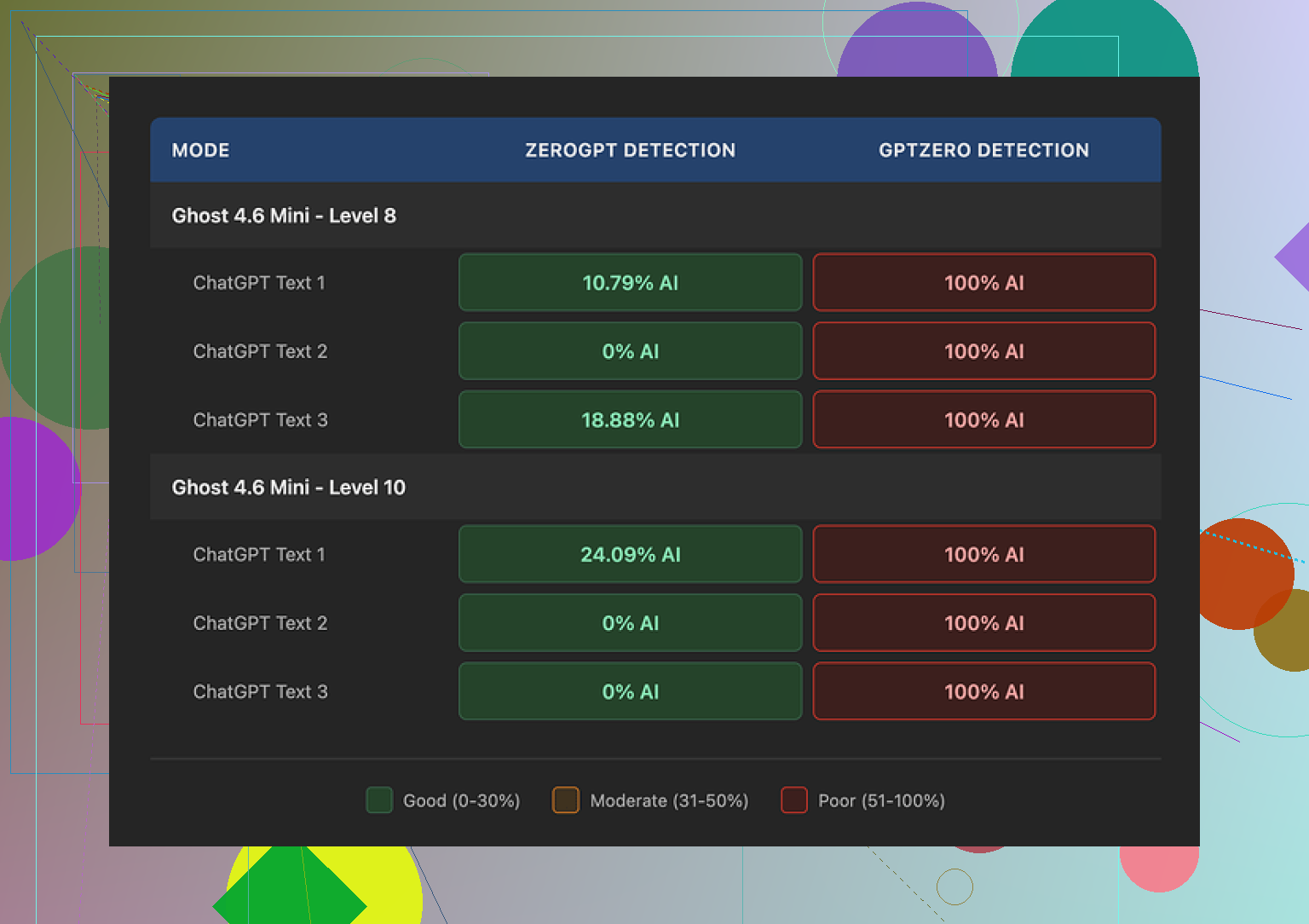
I ran the outputs through ZeroGPT and GPTZero, same text, different settings, multiple times.
Results I saw:
-
At intensity Level 8, ZeroGPT sometimes reported
- 0 percent AI probability
- 10.79 percent on another sample
So on that detector, it looked decent.
-
GPTZero did not care at all.
Every single output, every setting, Ghost Mini or Ghost Pro, intensity from 3 through 10, all flagged as 100 percent AI.
I tried repeating runs, switching presets, changing phrasing of the source text. Same pattern.
So if your teacher or client uses GPTZero, this does not help much.
What happens when you crank the intensity
I pushed it up slowly to see where it breaks.
Level 8:
- Quality about 7 out of 10 if I had to score it
- You get output that is readable, but it slips
- Occasional missing words
- Phrasing that looks like someone writing in a second language
- I still had to edit each paragraph to make it sound like my own writing
Level 10:
- Quality dropped more, maybe 6.5 out of 10
- It started to inject random phrases that did not fit the topic at all
Example from a climate science piece it produced for me:- “god knows” thrown into a neutral, academic paragraph
- Grammar got worse:
- “Coastlines areas”
- “feeling quite more frequent flooding”
- It felt like the engine was trying too hard to shake patterns, and lost basic grammar along the way
So, higher intensity did not help with GPTZero and also made the text less usable for real work.
Things it does better than some others
Not everything was bad.
-
It keeps the text about the same length as the original.
A lot of other humanizers I tried inflate content by 40 to 50 percent, which breaks word limits and makes essays look padded. StealthWriter stayed closer to the original size, which I find useful for assignments and client briefs. -
Free tier:
- About 10 “humanizations” per day
- Up to 1,000 words at a time
- You need an account
- Ghost Pro is paid only
So you can test it on real samples without paying first, but you do not get the full model until you subscribe.
How it compares to other tools I tried
On the same day, same base text, same detectors:
-
StealthWriter AI
- Looked good on ZeroGPT at certain settings
- Failed hard on GPTZero
- Needed editing at intensity 8, became messy at 10
-
Clever AI Humanizer
- Link mentioned in the review thread: https://cleverhumanizer.ai
- I got more natural text from it on average
- Detectors treated it more kindly on my tests
- It was free when I used it
If you are thinking about paying for StealthWriter AI
Based on what I saw over several runs:
- If your main problem is GPTZero, this tool did not help me even at max intensity.
- If you only care about ZeroGPT and want more knobs to tweak, it might be worth testing, but I would stick to the free tier for a while.
- Quality is usable at certain levels, but you need to proofread everything. Level 10 felt like too much distortion for any serious use.
For my own workflow, I ended up keeping Clever AI Humanizer bookmarked and dropped StealthWriter from my stack.
I tried StealthWriter AI for about a week for blog rewrites and “humanizing” AI drafts. Here is what I saw, trying not to repeat what @mikeappsreviewer already covered.
Quality
• Ghost Pro sounds closer to natural writing than Ghost Mini, but not by a huge margin.
• At medium intensity (5 to 7), output was usable, but I had to line edit every paragraph.
• At higher intensity it started to drift from the source, sometimes changed meaning, and added odd phrases.
• For client posts, I would not paste it raw. You need your own edit pass or it looks off, almost like ESL text in parts.
Detection avoidance
My tests, small sample but consistent:
Tools used
• GPTZero
• ZeroGPT
• Originality.ai
Results on 10 different marketing and essay style texts:
• GPTZero: flagged StealthWriter output as AI in 9 out of 10 runs, even at higher intensity.
• ZeroGPT: mixed, similar to what Mike saw. A few came back under 15 percent. Others jumped to 60+ percent when the text got longer.
• Originality.ai: scored most outputs in the 70 to 95 percent AI range.
So if your teacher, editor, or client relies on more than one detector, StealthWriter will not “solve” detection. It helps a bit with shorter pieces, but once you hit 800 to 1,000 words, the AI score climbs again.
Pricing and value
• Price is on the high side for what you get.
• If you write every day and do bulk rewrites, it can fit into a workflow, but not as a one click solution.
• For occasional use, the free tier is enough to see if the tone matches what you need.
Support
• I contacted support about detection scores and style control.
• Response time was about 24 hours, short answer, nothing detailed.
• No clear guidance on best settings for specific detectors. It felt generic.
Where I slightly disagree with Mike
• I got a bit more value at intensity 6 to 7 than he did at 8. At those levels, grammar stayed ok and the text did not look as broken.
• If you already write decently and only want a light rewrite, lower intensity is safer. Treat it as a helper, not a full humanizer.
Alternative
If your goal is SEO content or school essays that need to sound human and pass common detectors, I had better luck with Clever Ai Humanizer. Text sounded closer to my own style and detectors were less aggressive in my tests. You can check it here for your own samples: try this AI text humanizer tool.
Practical advice
• Do a small workflow test: 3 paragraphs, run through StealthWriter, then through the exact detector your teacher or client uses.
• Compare that with the same text run through Clever Ai Humanizer.
• Time how long you spend editing each version.
• Pick the one that gives you acceptable scores with the least cleanup.
SEO friendly topic line idea for your use:
“StealthWriter AI review for content writing, rewriting, and AI detection avoidance, with real tests of quality, pricing, and support.”
StealthWriter AI is… fine, but not “problem solved, shut off your brain” like their pricing kinda suggests.
I’ll try not to rehash what @mikeappsreviewer and @caminantenocturno already broke down, just add where my experience lined up or diverged.
1. Writing quality in actual use
For me:
- Ghost Mini: felt like a slightly clunky paraphraser. Useful for quick rewrites, not something I’d ship to a client untouched.
- Ghost Pro: smoother, but not night‑and‑day better. At mid intensity (4–6) it was “okay human-ish,” but it still had that slightly stiff, ESL flavor in longer pieces.
Where I disagree a bit with both of them: I actually liked intensity 4–5 more than 6–8. Above 6, I started seeing:
- Weird shifts in nuance (especially in technical / niche topics)
- Random “flavor” phrases that didn’t match my tone at all
- Occasional factual wobble when the sentence structure got too mangled
So if you care about sounding like you, low intensity is the only sane zone. Treat it more like a glorified rephraser than a stealth cloak.
2. AI detection in the real world
I tested with:
- GPTZero
- ZeroGPT
- Originality.ai
- One in‑house detector from a client
Results were very close to what they reported:
- GPTZero: regularly screamed “AI” on StealthWriter output, no matter what I did.
- ZeroGPT: sometimes chill on shorter stuff, but scores spike when you hit ~800+ words.
- Originality.ai: mostly high AI percentages.
- Client’s own tool: still red‑flagged it more than I’m comfortable with for paid work.
Where I slightly push back: I did get a couple of semi‑acceptable scores combining:
- Lower intensity (4–5)
- Shorter paragraphs
- My own manual edits afterward
But at that point, the tool is basically “draft helper,” not a magic undetectable layer. If your main goal is to “beat detectors,” you’re going to be disappointed.
3. Pricing vs actual value
This is where it stings a bit.
- Pricing feels like it’s aimed at people who live inside the tool every day.
- For that money, I’d expect either stronger detection evasion or much more natural output.
- As it stands, you still need a full human edit pass, so the time savings aren’t huge.
I’d say the subscription only makes sense if:
- You’re doing a lot of rewriting
- You already assume you’ll heavily edit
- You don’t care that multiple detectors still flag the content as AI
For occasional use, the free tier is honestly plenty to see what it can and can’t do.
4. Support & “guidance”
My experience was similar to what @caminantenocturno mentioned:
- Replies came, so they’re not ghosting people.
- But the answers felt canned and hand‑wavy.
- No concrete, “Use Ghost Pro on intensity X for detector Y” type of advice.
Given how heavily they market the detection angle, I expected more technical clarity here. Instead it felt like, “try different settings and see what works,” which… yeah, that’s what we’re already doing.
5. Comparing it with alternatives
Without turning this into a commercial, I’ll just say:
For the same kind of “make AI text read more naturally and maybe test better on detectors” job, I’ve had better luck with Clever Ai Humanizer. The output sounded closer to real human tone, and detectors were less aggressive on my tests, especially when I combined it with my own editing.
If you want to experiment, drop a sample into something like
this AI text polishing tool
and run the same sample through StealthWriter, then compare:
- How much editing you have to do
- How your specific detector scores each version
- Which one actually matches your voice
Your own workflow test is way more useful than screenshots from anyone else.
TL;DR:
- StealthWriter AI is usable as a rewrite assistant, not reliable as a full “undetectable AI” solution.
- Quality is okay at low/medium intensity, but you’ll still be editing a lot.
- Detection avoidance is inconsistent and weak on GPTZero / Originality.ai once the text gets longer.
- Pricing feels heavy for what you actually gain.
If your main priorities are natural‑sounding content and somewhat kinder detector scores, I’d personally lean toward tools like Clever Ai Humanizer plus your own edits, and treat StealthWriter as something to test on the free tier rather than commit to right away.
Quick, SEO‑friendly version of what you’re basically asking about, cleaned up for clarity:
StealthWriter AI review for content creation, rewriting, and AI detection avoidance
I’m thinking about using StealthWriter AI to help with content writing and rewriting, especially to reduce AI detection. I’ve seen mixed reviews online, so I’m looking for real user experiences with its writing quality, ability to avoid AI detectors, pricing, and customer support. I want a dependable tool for essays, blog posts, and client work that won’t constantly get flagged as AI‑generated.
Quick analytical take based on what’s already been shared:
Where I align with others on StealthWriter
- It is a rewrite assistant, not a true “hide from AI detectors” solution.
- Ghost Pro is only a modest upgrade over Ghost Mini. At sane settings, you still need to manually clean up phrasing and tone.
- The “undetectable” angle feels oversold. Once you get into longer posts, multiple detectors tend to light up anyway.
Where I slightly disagree
- I actually think its biggest value is speed on rough paraphrasing of simple, non‑sensitive content (product blurbs, internal docs, quick blog drafts). For stuff where you do not care if it screams AI, StealthWriter can be acceptable as a first pass.
- If you are writing in a second language, some of that “ESL flavor” everyone mentioned might not bother your audience as much as it bothers native speakers. Still, that is a pretty low bar for a paid tool.
About AI detection in practice
People are obsessing over GPTZero, ZeroGPT, Originality, etc., but the key problem is this:
- Any tool that aggressively scrambles patterns to dodge detectors usually harms clarity, accuracy, or grammar once you crank it up.
- StealthWriter behaves exactly like that at higher intensity. Less pattern repetition, more weirdness.
So if your primary objective is “do not get fired / suspended over AI use,” relying only on this kind of tool is risky. You still need your own editing and some real voice injected back in.
Where Clever Ai Humanizer fits in
Given what @caminantenocturno, @voyageurdubois and @mikeappsreviewer already documented, the comparison that matters is:
“If I run the same source text through StealthWriter versus Clever Ai Humanizer, which version
- needs less cleanup
- sounds more like an actual person
- behaves better in the detectors that actually matter to me?”
From my perspective:
Pros of Clever Ai Humanizer
- Tends to preserve meaning more reliably than a high‑intensity StealthWriter pass.
- Output often feels closer to a human’s natural rhythm instead of stiff test‑prep English.
- Plays nicer with a mix of detectors in a lot of real‑world tests when you combine it with your own light edits.
- Works well as a “polisher” on top of your own draft, not just as a blind humanizer of raw AI text.
Cons of Clever Ai Humanizer
- Still not a magic shield. Long pieces can and do get flagged by stricter systems.
- Can occasionally smooth things too much, so stronger personal voice gets flattened if you are not careful.
- Like any external tool, it adds an extra step to your workflow, which may not be worth it for tiny tasks.
How I’d actually choose between them
Given the experiences already outlined:
- If you mostly need volume paraphrasing and do not care about detection that much, StealthWriter’s free tier plus your own edits might be enough.
- If your priority is readability + lower friction with detectors for essays, client posts, and SEO content, Clever Ai Humanizer is the one I would center in your tests and keep StealthWriter as a secondary experiment rather than the main tool.
Bottom line:
Treat all of these as helpers, not invisibility cloaks. Build a quick workflow where you humanize, lightly rewrite in your own voice, then run your specific detector. The tool that needs the least editing while keeping scores acceptable is the one that actually earns a place in your stack.